Role: Lead Systems Architect & AI Designer | Timeline: Continuous Integration
1. Executive Summary: Redefining the Portfolio
2. The Challenge: The "Search-Experience" Gap
Most portfolios rely on chronological lists or basic keyword tagging. For a Principal-level architect, this is insufficient. The challenge was threefold:
- Information Density: How to make 50+ deep-dive research papers and case studies accessible without overwhelming the user.
- Truth & Grounding: Ensuring an AI assistant only speaks the truth about my career, with zero hallucinations.
- Scalable Observability: Understanding who is looking at what without compromising the professional, minimalist UX.
3. Architecture: The Agentic Core
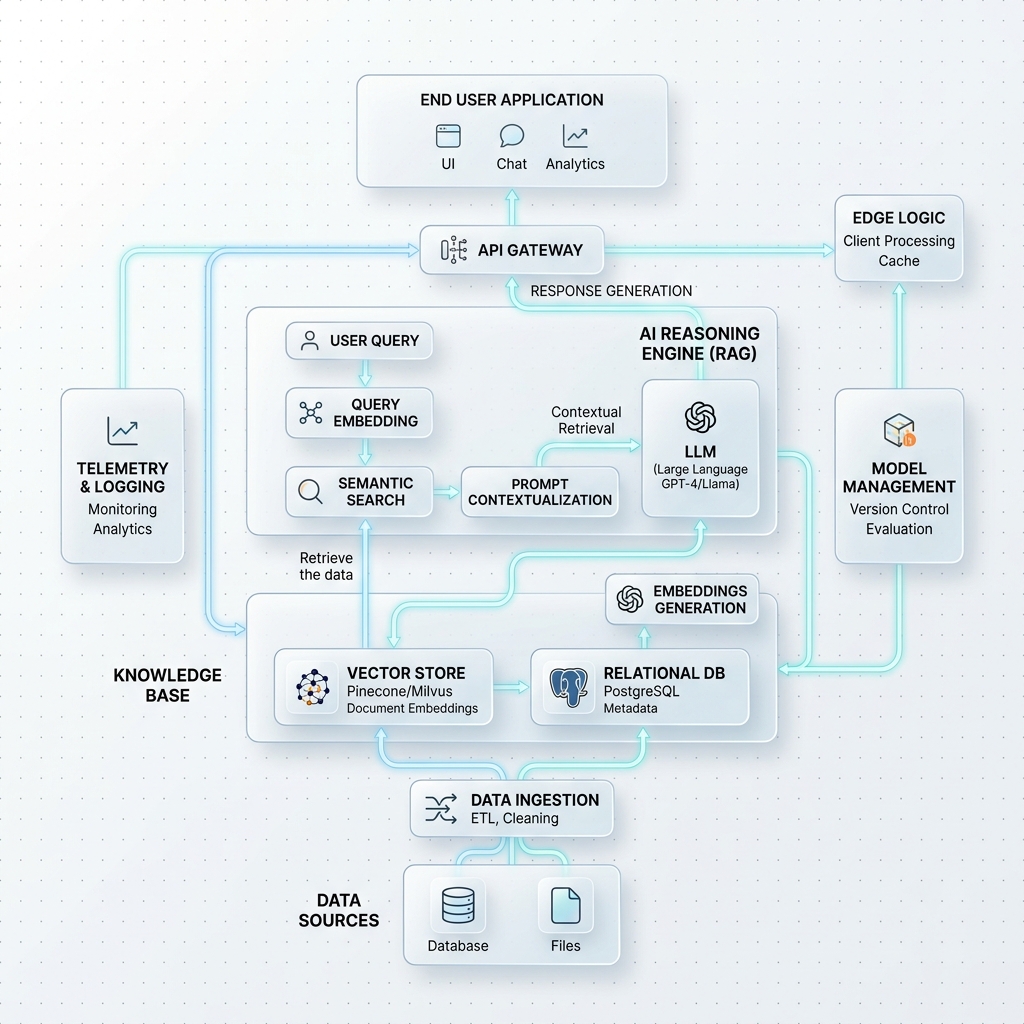
The system is built on a high-fidelity RAG (Retrieval-Augmented Generation) stack using Next.js 15, Supabase, and Gemini 2.5.
A. Semantic Retrieval via PGVector
We bypassed traditional database lookups for a Vectorized Search. Every sentence in this repository is converted into a 3072-dimensional vector. When a user asks a question, the system performs a cosine similarity search to find the exact "clusters" of knowledge that match the intent.
B. The HyDE Pattern
To solve the "cold start" problem in search, I implemented Hypothetical Document Embeddings (HyDE). The system actually "guesses" what the answer might look like before it searches the database. This allows it to bridge the gap between user intent and technical terminology.
C. Corrective RAG (CRAG)
To ensure 100% accuracy, I built a Corrective Layer. If the retrieved documents don't meet a high similarity threshold, the AI politely declines to answer rather than making something up. This is critical for maintaining professional trust.
4. Observability: Tracking the Global Footprint
One of the most powerful features of Theorycraft is its Live Interaction Tracker. I built a custom telemetry system that captures:
- Real-Time Geolocation: Using Vercel Edge headers to map visitor locations from San Francisco to Bangalore in milliseconds.
- Semantic Query Tracking: Monitoring "what" recruiters are searching for to refine the content strategy.
- Intelligent Rate Limiting: A custom-built throttle (15 queries/hour) that protects the LLM from abuse while ensuring a premium experience.
5. Impact & Engineering Metrics
The implementation of Theorycraft has transformed my professional outreach from a "one-way broadcast" into a "two-way intelligence exchange."
"Theorycraft is the ultimate MVP of agentic architecture. It proves that the most valuable part of a design system isn't the components—it's the intelligence that connects them."